
Effectieve pedagogische ondersteuning voor inclusief basisonderwijs
In een inclusieve klas hebben leerlingen uiteenlopende ondersteuningsbehoeften. Pedagogische ondersteuning helpt hen optimaal mee te doen en zich te ontwikkelen.
Bijdrage van Ivonne Douma (RENN4) , Anke de Boer (RENN4, Rijksuniversiteit Groningen) , Klaasje Bruining (RENN4) , Bernadette Evers (RENN4) , Klaaske Kuiper (RENN4) , Annemarie Muis (RENN4) , Mariët Lalkens-Gast (RENN4) Meer informatie
Gepubliceerd:
Inclusief onderwijs heeft als doel dat alle leerlingen gelijke onderwijskansen krijgen, ongeacht hun ondersteuningsbehoeften. Dit betekent dat je binnen de klas te maken krijgt met een grotere diversiteit aan onderwijs- en ondersteuningsbehoeften van leerlingen. Als leerkracht wil je kunnen aansluiten bij die behoeften.
In de praktijk ervaren leraren regelmatig handelingsverlegenheid bij het omgaan met leerlingen met ondersteuningsbehoeften op het gebied van gedrag
Aas, H. K., Uthus, M., & Løhre, A. (2024). Inclusive education for students with challenging behaviour: Development of teachers’ beliefs and ideas for adaptations through Lesson Study. European Journal of Special Needs Education, 39(1), 64–78. https://doi.org/10.1080/08856257.2023.2191107
Hemmings, B. (2017). Teachers’ concerns about inclusion: Evidence from primary settings. Australasian Journal of Special Education, 41(1), 48–60. https://doi.org/10.1017/jse.2016.5
Vooral wanneer het gaat om externaliserend gedrag, zoals druk of impulsief gedrag, verstorend gedrag of boos gedrag richting medeleerlingen, de leerkracht of de omgeving. Ook internaliserende gedragsproblemen, zoals teruggetrokken of angstig gedrag kunnen het functioneren in de klas beïnvloeden
Koster, M., Pijl, S. J., Nakken, H., & Van Houten, E. (2010). Social participation of students with special needs in regular primary education in the Netherlands. International Journal of Disability, Development and Education, 57(1), 59–75. https://doi.org/10.1080/10349120903537905
Geraadpleegde bronnen
Aas, H. K., Uthus, M., & Løhre, A. (2024). Inclusive education for students with challenging behaviour: Development of teachers’ beliefs and ideas for adaptations through Lesson Study. European Journal of Special Needs Education, 39(1), 64–78. https://doi.org/10.1080/08856257.2023.2191107Hemmings, B. (2017). Teachers’ concerns about inclusion: Evidence from primary settings. Australasian Journal of Special Education, 41(1), 48–60. https://doi.org/10.1017/jse.2016.5
Koster, M., Pijl, S. J., Nakken, H., & Van Houten, E. (2010). Social participation of students with special needs in regular primary education in the Netherlands. International Journal of Disability, Development and Education, 57(1), 59–75. https://doi.org/10.1080/10349120903537905
Didactische ondersteuning
Effectieve pedagogische ondersteuning kun je niet los zien van de didactische ondersteuning in de klas. Duidelijke instructie, hoge betrokkenheid en effectieve klassenmanagementstrategieën hangen samen met minder probleemgedrag
Simonsen, B., Fairbanks, S., Briesch, A., Myers, D., & Sugai, G. (2008). Evidence-based practices in classroom management*. Education and Treatment of Children, 31*(3), 351–380. https://www.jstor.org/stable/42900076
Zo ontstaat er een wisselwerking tussen didactische en pedagogische opbrengsten. En dit draagt weer bij aan inclusief onderwijs.
Geraadpleegde bronnen
Simonsen, B., Fairbanks, S., Briesch, A., Myers, D., & Sugai, G. (2008). Evidence-based practices in classroom management*. Education and Treatment of Children, 31*(3), 351–380. https://www.jstor.org/stable/42900076Lees ook
Het overzichtsartikel over effectieve didactische ondersteuning.
Om leerlingen met ondersteuningsbehoeften op het gebied van gedrag pedagogisch goed te kunnen ondersteunen, draait het vooral om interacties tussen leerlingen onderling en tussen de leerlingen en de leerkracht. In dit artikel vind je handvatten om deze interacties positief te bevorderen en lees je welke competenties leerkrachten en schoolteams nodig hebben om deze ondersteuning te bieden.
Pedagogische ondersteuning op verschillende niveaus
Om de ondersteuning bewust en gericht in te zetten kun je gebruikmaken van het Multi-Tiered System of Support (MTSS), zie Figuur 1
Nitz, J., Brack, F., Hertel, S., Krull, J., Stephan, H., Hennemann, T., & Hanisch, C. (2023). Multi-tiered systems of support with focus on behavioral modification in elementary schools: A systematic review. Heliyon, 9(6), e17506. https://doi.org/10.1016/j.heliyon.2023.e17506
Het MTSS is een raamwerk voor de ondersteuning die je in de klas biedt aan leerlingen met verschillende ondersteuningsbehoeften en bestaat uit drie niveaus:
- Op niveau 1 staat de pedagogische basisondersteuning die je inzet voor de hele klas, zoals preventief klassenmanagement en sterke leerkrachtcompetenties.
- Op niveau 2 gaat het om gerichte ondersteuning aan kleine groepen leerlingen, zoals een training sociale vaardigheden.
- Op niveau 3 gaat het om heel specifieke ondersteuning voor een individuele leerling, bijvoorbeeld hulp om emoties te herkennen en hoe je hiermee kunt omgaan.
Geraadpleegde bronnen
Nitz, J., Brack, F., Hertel, S., Krull, J., Stephan, H., Hennemann, T., & Hanisch, C. (2023). Multi-tiered systems of support with focus on behavioral modification in elementary schools: A systematic review. Heliyon, 9(6), e17506. https://doi.org/10.1016/j.heliyon.2023.e17506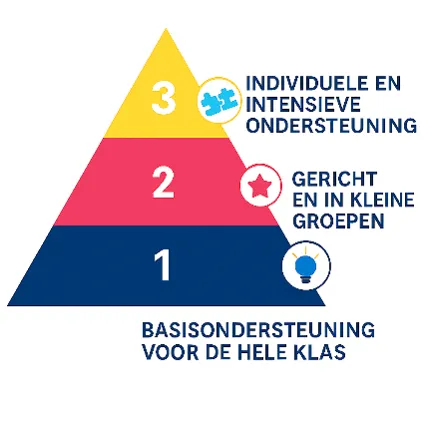
Om leerlingen met extra ondersteuningsbehoeften op het gebied van gedrag goed pedagogisch te ondersteunen, is het vaak niet nodig om allerlei nieuwe vaardigheden te leren. Juist bij deze leerlingen is het belangrijk om de pedagogische basisvaardigheden die je al hebt bewust, doelgericht en consistent in te zetten. Binnen MTSS vormen deze basisvaardigheden de ondersteuning op niveau 1. Wanneer deze ondersteuning onvoldoende blijkt, kun je intensiveren naar niveau 2 of 3.
Een sterke basis op niveau 1 is dan ook een belangrijke voorwaarde voor effectieve ondersteuning op niveau 2 en 3
Simonsen, B., Fairbanks, S., Briesch, A., Myers, D., & Sugai, G. (2008). Evidence-based practices in classroom management*. Education and Treatment of Children, 31*(3), 351–380. https://www.jstor.org/stable/42900076
Onderzoek bij interventies op deze niveaus altijd eerst of de basisvaardigheden op niveau 1 voldoende en doeltreffend zijn ingezet. Vanuit die stevige basis kun je werken aan de ontwikkeling van gedragsregulatie én betekenisvolle participatie van alle leerlingen binnen de klas.
In dit artikel staat het versterken van niveau 1 daarom centraal. Daarbij richten we ons vooral op de interacties tussen leerlingen onderling en interacties tussen leerlingen en de leerkracht, omdat juist in deze interacties veel kansen liggen om gedrag en participatie positief te beïnvloeden. Als leerkracht speel je een belangrijke rol in het vormgeven en begeleiden van deze interacties. In dit artikel lees je hoe je dat kunt doen, met waar nodig een verwijzing naar niveau 2 en 3 van het MTSS. Deze meer specifieke interventies worden echter niet uitgebreid besproken.
Sociale participatie
Meer positieve sociale interacties tussen groepen leerlingen zijn gunstig voor hun ontwikkeling
Fisher, D., Roach, V., & Frey, N. (2002). Examining the general programmatic benefits of inclusive schools. International Journal of Inclusive Education, 6(1), 63–78. https://doi.org/10.1080/13603110010035843
Koster, M., Pijl, S. J., van Houten-van den Bosch, E. J., & Nakken, H. (2007). The social position and development of pupils with SEN in mainstream Dutch primary schools. European Journal of Special Needs Education, 22(1), 31–46. https://doi.org/10.1080/08856250601082265
Pijl, S. J., Frostad, P., & Flem, A. (2008). The social position of pupils with special needs in regular schools. Scandinavian Journal of Educational Research, 52(4), 387–405. https://doi.org/10.1080/00313830802184558
Sociale participatie van leerlingen kan dan ook gezien worden als één van de doelstellingen van inclusief onderwijs. Positieve sociale participatie wordt gekenmerkt door vier aspecten
Koster, M., Nakken, H., Pijl, S. J., & van Houten, E. (2009). Being part of the peer group: A literature study focusing on the social dimension of inclusion in education. International Journal of Inclusive Education, 13(2), 117–140. https://doi.org/10.1080/13603110701284680
- een positief (sociaal) zelfconcept,
- acceptatie door de leerkracht en medeleerlingen,
- vriendschappen met klasgenoten en
- positieve interacties met klasgenoten.
Voor leerlingen met ondersteuningsbehoeften op het gebied van gedrag is sociale acceptatie niet vanzelfsprekend. Zo ervaren zij vaak moeilijkheden bij positieve interacties met klasgenoten, met de leerkracht en met de leeromgeving (e.g.,
Avramidis, E., Aroni, K., & Strogilos, V. (2022). Social participation and quality of best friendship of students with moderate learning difficulties in early adolescence: A longitudinal study. Australasian Journal of Special and Inclusive Education, 46(1), 1–16. https://doi.org/10.1017/jsi.2022.3
Schürer, S., & Van Ophuysen, S. (2022). Relationship between group cohesion and social participation of pupils with learning and behavioural difficulties. European Journal of Special Needs Education, 37(5), 866–881. https://doi.org/10.1080/08856257.2021.1963150
Zurbriggen, C. L. A., Hofmann, V., Lehofer, M., & Schwab, S. (2021). Social classroom climate and personalised instruction as predictors of students’ social participation. International Journal of Inclusive Education, 25(11), 1223–1238. https://doi.org/10.1080/13603116.2021.1882590
Ze worden vaker buitengesloten en minder vaak geaccepteerd door hun klasgenoten. Daarnaast hebben ze vaak minder vrienden dan andere leerlingen en beoordelen ze de kwaliteit van hun vriendschappen lager
Avramidis, E. (2013). Self-concept, social position and social participation of pupils with SEN in mainstream primary schools. Research Papers in Education, 28(4), 421–442. https://doi.or g/10.1080/02671522.2012.673006
Douma, I. (2024). Me myself and I: Explaining the self-concept of students in mainstream and special education through the eyes of their peers. [Doctoral dissertation, Rijksuniversiteit Groningen]. University of Groningen. https://doi.org/10.33612/diss.872395709
Monchy, M. D., Pijl, S. J., & Zandberg, T. (2004). Discrepancies in judging social inclusion and bullying of pupils with behaviour problems. European journal of special needs education, 19(3), 317-330. http://dx.doi.org/10.1080/0885625042000262488
Zij hebben daarom op het gebied van gedrag vooral baat bij pedagogische ondersteuning rondom interacties binnen de klas
Bronfenbrenner, U. (1979). The ecology of human development: Experiments by nature and design. Harvard University Press.
Zowel interactie met medeleerlingen, als met de leerkracht en de omgeving.
Interactie met medeleerlingen
Acceptatie door klasgenoten, vriendschappen en positieve interacties zijn belangrijke aspecten van sociale participatie
Koster, M., Nakken, H., Pijl, S. J., & van Houten, E. (2009). Being part of the peer group: A literature study focusing on the social dimension of inclusion in education. International Journal of Inclusive Education, 13(2), 117–140. https://doi.org/10.1080/13603110701284680
Voor leerlingen met ondersteuningsbehoeften op het gebied van gedrag zijn deze sociale relaties niet vanzelfsprekend. Het bevorderen van positieve interacties tussen leerlingen kan daarom veel opleveren, zoals een positiever zelfconcept, meer schoolbetrokkenheid, meer motivatie en betere leerprestaties
Douma I., Warrens M., de Boer A. & Minnaert A. (2025). Predicting peer acceptance among students with and without special educational needs in secondary educational settings. Front. Dev. Psychol. https://doi.org/10.3389/fdpys.2025.1380004
Wentzel, K. R. (2005). Peer relationships, motivation, and academic performance at school. In A. Elliot & C. Dweck (Eds.), Handbook of competence and motivation (pp. 279–296). Guilford.
Wentzel, K. R., & Watkins, D. E. (2002). Peer relationships and collaborative learning as contexts for academic enablers. School Psychology Review, 31(3), 366–377. https://doi.org/10.1080/02796015.2002.12086161
Om leerlingen met ondersteuningsbehoeften op het gebied van gedrag pedagogisch succesvol te ondersteunen in de klas, sluit je aanpak bij voorkeur aan bij álle leerlingen. Door de basisondersteuning vanuit niveau 1 te verdiepen en uit te breiden op niveau 2, kun je een grote groep leerlingen goed ondersteunen.
Sociale acceptatie en de voorbeeldfunctie van de leerkracht
Leerlingen gebruiken het gedrag van de leerkracht als voorbeeld voor hoe ze andere leerlingen benaderen en accepteren. Door deze sociale referentie speel je daarmee als leerkracht een belangrijke rol in de acceptatie van leerlingen in de klas. In het bijzonder voor leerlingen met ondersteuningsbehoeften op het gebied van gedrag is jouw invloed groot
Hendrickx, M. M. H. G., Mainhard, T., Oudman, S., Cillessen, A. H. N., & Brekelmans, M. (2019). Leerkrachtgedrag en de kwaliteit van sociale relaties in de klas: De leerkracht als sociale referent voor de sociale status van de leerling. Kind en Adolescent, 40(1), 67–88. https://doi.org/10.1007/s12453-018-00195-z
Endedijk, H. M., Breeman, L. D., van Lissa, C. J., Hendrickx, M. M. H. G., den Boer, L., & Mainhard, T. (2021). The Teacher’s Invisible Hand: A Meta-Analysis of the Relevance of Teacher–Student Relationship Quality for Peer Relationships and the Contribution of Student Behavior. Review of Educational Research, 92(3), 370-412. https://doi.org/10.3102/00346543211051428
Hughes, J. N., Cavell, T. A., & Willson, V. (2001). Further evidence for the developmental significance of the quality of the teacher–student relationship. Journal of School Psychology, 39(4), 289–301. https://doi.org/10.1016/S0022-4405(01)00074-7
Door positief te praten over en te interacteren met een leerling, geef je aan de leerling zelf en aan medeleerlingen het signaal af dat je deze accepteert en waardeert. Dit draagt positief bij aan de acceptatie en het zelfconcept van de leerling
Douma, I. (2024). Me myself and I: Explaining the self-concept of students in mainstream and special education through the eyes of their peers. [Doctoral dissertation, Rijksuniversiteit Groningen]. University of Groningen. https://doi.org/10.33612/diss.872395709
Erkman, F., Caner, A., Sart, Z. H., Börkan, B., & Şahan, K. (2010). Influence of perceived teacher acceptance, self-concept, and school attitude on the academic achievement of school-age children in Turkey. Cross-Cultural Research: The Journal of Comparative Social Science, 44(3), 295–309. https://doi.org/10.1177/1069397110366670
Het tegenovergestelde is ook waar: wanneer je je negatief uitlaat tegen of over een leerling, geeft dit een negatief signaal af aan de leerling en de medeleerlingen. Dit kan leiden tot minder acceptatie en een negatiever zelfconcept
Hendrickx, M. M. H. G., Mainhard, T., Oudman, S., Cillessen, A. H. N., & Brekelmans, M. (2019). Leerkrachtgedrag en de kwaliteit van sociale relaties in de klas: De leerkracht als sociale referent voor de sociale status van de leerling. Kind en Adolescent, 40(1), 67–88. https://doi.org/10.1007/s12453-018-00195-z
Dit betekent overigens niet dat je geen correcties mag geven. Het is hierbij van belang dat de correctie gaat over het gedrag en niet over de leerling als individu. Feedback gericht op de leerling heeft namelijk een grotere invloed op de sociale acceptatie van een leerling dan taakgerichte feedback
Nicolay, P., & Huber, C. (2023). A question of feedback? Studying effects of academic performance and teacher feedback on primary school students’ social acceptance in an experimental setting. Frontiers in Education, 8, 1234739. https://doi.org/10.3389/feduc.2023.1234739
Lees meer over positieve relaties in de klas in de leidraad Leerkracht-leerlingrelaties in het po.
Vriendschappen stimuleren
Voor leerlingen met ondersteuningsbehoeften op het gebied van gedrag kunnen vriendschappen helpen om gedrag te reguleren en problemen te verminderen. Het hebben van één goede vriend vormt al een beschermende factor voor een leerling
Bagwell, C. L., & Schmidt, M. E. (2011). Friendships in childhood and adolescence. Guilford Press.
Vriendschappen helpen leerlingen ook om te functioneren in de klas en om buitensluiting tegen te gaan
Bukowski, W. M., Newcomb, A. F., & Hartup, W. W. (1996). The company they keep: Friendship in childhood and adolescence. Cambridge University Press.
Rubin, K. H., Bukowski, W., & Laursen, B. (2009). Handbook of peer interactions, relationships, and groups. Guilford Press.
Acceptatie is een voorwaarde om tot vriendschappen te komen
Douma, I. (2024). Me myself and I: Explaining the self-concept of students in mainstream and special education through the eyes of their peers. [Doctoral dissertation, Rijksuniversiteit Groningen]. University of Groningen. https://doi.org/10.33612/diss.872395709
Rubin, K. H., Bukowski, W., & Laursen, B. (2009). Handbook of peer interactions, relationships, and groups. Guilford Press.
Door acceptatie binnen de klas te stimuleren kan een leerkracht ruimte creëren voor het ontstaan van nieuwe vriendschappen. Om elkaar te accepteren en vriendschappen te vormen, helpt het wanneer leerlingen elkaar beter begrijpen. Wanneer ze inzien waarom iemand bepaald gedrag laat zien, zullen ze diegene minder afwijzen
Farmer, T. W., McAuliffe Lines, M., & Hamm, J. V. (2011). Revealing the invisible hand: The role of teachers in children’s peer experiences. Journal of Applied Developmental Psychology, 32(5), 247–256. https://doi.org/10.1016/j.appdev.2011.04.006
Als leerkracht kun je verschillen in emotieregulatie, gedrag, prikkelverwerking of sociale behoeften van leerlingen binnen de klas klassikaal bespreken. Hierbij is het belangrijk dat je geen individuele leerlingen bij naam noemt. Dit vergroot juist de kans op afwijzing. Daarnaast helpt het als je overeenkomsten tussen leerlingen benoemt, omdat leerlingen vaak vrienden worden met leerlingen die op hen lijken of overeenkomsten met hen hebben. Zoals een gedeelde interesse in voetbal, een passie voor dieren of allebei goed zijn in rekenen.
Om de acceptatie en vriendschapsvorming tussen leerlingen onderling verder te bevorderen is het belangrijk dat ze met elkaar optrekken en samenwerken op school. Door coöperatief aan groepsopdrachten te werken gaan leerlingen positieve interacties met elkaar aan en kan acceptatie en vriendschap ontstaan
Johnson, D. W., & Johnson, R. T. (2009). An educational psychology success story: Social interdependence theory and cooperative learning. Educational Researcher, 38(5), 365–379. https://doi.org/10.3102/0013189X09339057
Er zijn wel voorwaarden verbonden aan een goede samenwerking die bijdraagt aan meer onderlinge acceptatie. Hiervoor is het belangrijk dat leerlingen werken aan een gezamenlijk doel en dat ze een gelijkwaardige rol hebben in de opdracht
Slavin, R. E. (2014). Cooperative learning and academic achievement: Why does groupwork work? Anales de Psicología, 30(3), 785–791. https://doi.org/10.6018/analesps.30.3.201201
Johnson, D. W., & Johnson, R. T. (2009). An educational psychology success story: Social interdependence theory and cooperative learning. Educational Researcher, 38(5), 365–379. https://doi.org/10.3102/0013189X09339057
Bij de keuze welke leerlingen je laat samenwerken, werkt het vaak het beste wanneer leerlingen niet te sterk van elkaar verschillen. Koppel daarom leerlingen aan elkaar die een bepaalde mate van overeenkomst hebben in gedrag, interesses en cognitief niveau. Leerlingen die te sterk van elkaar verschillen belanden eerder in conflicten, wat juist niet helpend is om de onderlinge acceptatie en vriendschap te bevorderen
Snyder, J., McEachern, A., Schrepferman, L., Just, C., Jenkins, M., Roberts, S., & Lofgreen, A. (2010). Contribution of peer deviancy training to the early development of conduct problems: mediators and moderators. Behavior therapy, 41(3), 317–328. https://doi.org/10.1016/j.beth.2009.05.001
Dishion, T. J., McCord, J., & Poulin, F. (1999). When interventions harm: Peer groups and problem behavior. American Psychologist, 54(9), 755–764. https://doi.org/10.1037/0003-066X.54.9.755
Sociale veiligheid bevorderen met positieve interacties
Ook de sociale veiligheid in de klas is belangrijk voor de pedagogische ondersteuning van leerlingen. Een sociaal veilig klasklimaat is een voorwaarde om tot leren en tot sociaal-emotionele ontwikkeling te komen
Brekelmans, M., Tartwijk van , J., & Severiens, S. (2014). Sociaal emotioneel klimaat in de klas. Pedagogische Studiën, 91(5). https://pedagogischestudien.nl/article/view/14206
Sociale veiligheid in de klas draagt bij aan de onderlinge samenwerking tussen leerlingen, het geeft ruimte aan onderlinge verschillen van leerlingen en vermindert negatieve sociale interacties, zoals uitsluiting en pesten
Niejenhuis, C. van, Huitsing, G., Veenstra, D., Anthonijsz, I. & Abrahamse, S. (2017). Samen met ouders werken aan een fijne school. Effectiviteitsonderzoek en praktijkvalidatie. Utrecht/Groningen: Nederlands Jeugdinstituut / Rijksuniversiteit Groningen.
Leerlingen met gedragsproblemen hebben vaker een kwetsbare sociale positie door uitsluiting
Douma, I. (2024). Me myself and I: Explaining the self-concept of students in mainstream and special education through the eyes of their peers. [Doctoral dissertation, Rijksuniversiteit Groningen]. University of Groningen. https://doi.org/10.33612/diss.872395709
Swart, F. de, Scholte, R. H. J., Delsing, M. J. M. H., van Efferen, E., van der Stege, H., Nelen, W., & Burk, W. J. (2022). Behavioral classroom norms in special education: Associations with peer acceptance and rejection*.* International Journal of Behavioral Development, 44(5), 404–414. https://doi.org/10.1177/0165025419885028
Als leerkracht kun je hierin actief een rol spelen door inclusieve waarden en sociale uitsluiting zichtbaar en bespreekbaar te maken in de klas
Finet, C., Vandebosch, H., Lubon, A., & Colpin, H. (2023). Supporting teachers to actively respond to bullying and to build positive relationships with their students: Effects of the T-SUPPORT training*.* Frontiers in Psychology, 14, 1236262. https://doi.org/10.3389/fpsyg.2023.1236262
Gest, S. D., & Rodkin, P. C. (2011). Teaching practices and elementary classroom peer ecologies. Journal of Applied Developmental Psychology, 32(5), 288–296. https://doi.org/10.1016/j.appdev.2011.02.004
Je kunt (subtiele) vormen van uitsluiting actief signaleren en hier direct en consequent op reageren. Bovendien kan je bestaande positieve relaties met kwetsbare leerlingen versterken. Je kunt bijvoorbeeld benoemen dat je zag dat niet iedereen werd uitgenodigd om mee te doen tijdens een opdracht en hierover vragen stellen aan de klas. Wat gebeurt er in een groep als iemand niet wordt meegenomen? Hoe zou het zijn voor een leerling als die niet mag meedoen en hoe kun je ervoor zorgen dat iedereen een bijdrage levert aan de samenwerking? Ook kun je interacties sturen door bijvoorbeeld zelf groepjes in te delen, door de groepsindeling te sturen (ik wil dat jullie wisselen, zodat iedereen met iedereen werkt) en te controleren of iedereen meedoet (heeft iedereen een bijdrage geleverd?).
Interactie met de leerkracht en omgeving
Positieve leerkracht-leerlinginteracties en goed klassenmanagement vormen de basis van effectieve pedagogische ondersteuning voor alle leerlingen en in het bijzonder voor leerlingen met ondersteuningsbehoeften op het gebied van gedrag
Doumen, S., Verschueren, K., Buyse, E., De Laet, S., & Van Damme, J. (2022). Reciprocal associations between teacher-student relations and students' externalizing behavior in elementary education? A within-dyad analysis. Journal of School Psychology, 90, 1–18. https://doi.org/10.1016/j.jsp.2021.10.004
Korpershoek, H., de Boer, H., & Mouw, J. M. (2025). An update of the meta-analysis of the effects of classroom management interventions on students’ academic, behavioral, social-emotional, and motivational outcomes. Review of Educational Research, 0(0). https://doi.org/10.3102/00346543251361903
Positieve groepsnormen ondersteunen weer de groepsdynamiek in de klas.
Goede leerkracht-leerlingrelaties opbouwen
Een positieve leerkracht-leerling relatie creëren is een van de meest belangrijke basiscompetenties van een leerkracht op niveau 1 van het MTSS. Ook voor een effectieve pedagogische ondersteuning op niveau 2 en 3 is dit van doorslaggevend belang. Een goede relatie met je leerlingen draagt bij aan meer betrokkenheid van je leerlingen en minder probleemgedrag in de klas
Cornelius-White, J. (2007). Learner-Centered Teacher-Students Relationships Are Effective: A Meta-Analysis. Review of Educational Research, 77, 113-143.
https://doi.org/10.3102/003465430298563
Een goede leerkracht-leerlingrelatie draagt daarnaast bij aan de zelfregulerende vaardigheden van leerlingen en vermindert daarmee externaliserend gedrag in de klas, zoals boosheid
Cadima, J., Verschueren, K., Leal, T., & Guedes, C. (2016). Classroom interactions, dyadic teacher– child relationships, and self–regulation in socially disadvantaged young children. Journal of Abnormal Child Psychology, 44(1), 7–17. https://doi.org/10.1007/s10802-015-0060-5
Leerkrachten noemen een positieve relatie met hun leerlingen zelf dan ook als één van de belangrijkste manieren om effectieve pedagogisch ondersteuning te geven in de klas
De Leeuw, R.R., De Boer, A. & Minnaert, A. (2018) What do Dutch general education teachers do to facilitate the social participation of students with SEBD?, International Journal of Inclusive Education, DOI: 10.1080/13603116.2018.1514081
Een goede leerkracht-leerlingrelatie bouw je op door je leerlingen te leren kennen en oprechte interesse in hen te tonen, door een luisterend oor te bieden, door mee te denken en door regelmatig te checken hoe het met ze gaat. Als je leerlingen met ondersteuningsbehoeften op het gebied van gedrag moet corrigeren, is het extra belangrijk dat je dit doet vanuit een warme relatie. Deze leerlingen hebben vaak al te maken gehad met veel negatieve reacties vanwege hun gedrag en zijn daardoor vaak sensitiever voor negatief gebrachte correcties
De Leeuw, R.R., De Boer, A. & Minnaert, A. (2018) What do Dutch general education teachers do to facilitate the social participation of students with SEBD?, International Journal of Inclusive Education, DOI: 10.1080/13603116.2018.1514081
Bovendien zijn correcties effectiever wanneer ze worden voorafgegaan door positieve interacties en wanneer leerlingen zich gezien en begrepen voelen
Cornelius-White, J. (2007). Learner-Centered Teacher-Students Relationships Are Effective: A Meta-Analysis. Review of Educational Research, 77, 113-143.
https://doi.org/10.3102/003465430298563
Lees meer over relaties met je leerlingen opbouwen en onderhouden in de leidraad Leerkracht-leerlingrelaties in het primair onderwijs.
Positief klassenmanagement
Leerlingen met gedragsproblemen hebben meer dan andere leerlingen baat bij structuur, voorspelbaarheid en duidelijke verwachtingen. Voor deze leerlingen zijn herhaling en duidelijkheid helpend om ongewenst gedrag te voorkomen of bij te sturen
Aldabbagh R., Glazebrook C., Sayal K. & Daley D. (2022). Systematic Review and Meta-Analysis of the Effectiveness of Teacher Delivered Interventions for Externalizing Behaviors. J Behav Educ. 2022 Sep 3:1-42. doi: 10.1007/s10864-022-09491-4.
Maak daarom expliciet welk gedrag je graag wil zien in de klas, benoem vooraf je verwachtingen en zorg dat je consequent bent in je handelen. Wanneer dit duidelijk is voor je leerlingen, zullen zij dit gedrag ook makkelijker laten zien. Op deze manier kan je op niveau 1 van het MTSS al een stevige basisondersteuning bieden.
Op niveau 2 van het MTSS is een verdieping nodig wanneer je je verwachtingen uitspreekt naar leerlingen toe: er is meer herhaling nodig en vooral duidelijkheid is van belang. Denk bijvoorbeeld aan het herhalen van de verwachting die je hebt van het gedrag wanneer leerlingen op de gang lopen (ik verwacht dat je in de gang rustig wandelt) of wanneer een leerling tijdens een werkmoment een vraag heeft (ik verwacht dat je je vinger opsteekt als je een vraag hebt). Voor sommige leerlingen kan daarnaast specifieke ondersteuning nodig zijn op niveau 3 van het MTSS. Denk bijvoorbeeld aan een leerling die bij overprikkeling naar een tafel in de hoek van het lokaal mag lopen om daar te gaan werken.
Lees meer over klassenmanagement in de leidraad Klassenmanagement in het primair onderwijs.
Positieve groepsnormen vormen
Groepsnormen spelen een belangrijke rol in de groepsdynamiek van een klas. Groepsnormen zijn de gedeelde verwachtingen richting elkaar over wat normaal en geaccepteerd gedrag is binnen de groep en wat als leuk of stoer gedrag wordt gezien
Rodkin, P. C., & Ryan, A. M. (2011). Child and adolescent peer relations in educational context. APA Educational Psychology Handbook, Vol 2: Individual Differences and Cultural and Contextual Factors., 2(200900174), 363–389. https://doi.org/10.1037/13274-015
Gest, S. D., & Rodkin, P. C. (2011). Teaching practices and elementary classroom peer ecologies. Journal of Applied Developmental Psychology, 32(5), 288–296. https://doi.org/10.1016/j.appdev.2011.02.004
Wanneer storend gedrag bijvoorbeeld de groepsnorm is, zullen leerlingen zich ook vaker storend gedragen in de klas. Omgekeerd kunnen positieve groepsnormen, zoals samenwerking en prosociaal gedrag, zorgen voor minder probleemgedrag in de klas.
Als leerkracht kun je de groepsnormen beïnvloeden door gewenst gedrag zichtbaar te waarderen en positief te bekrachtigen en door interacties tussen leerlingen te sturen. Ook samen met de klas groepsnormen bespreken, concretiseren en vaststellen draagt bij aan positieve groepsnormen
Farmer, T. W., Dawes, M., Hamm, J. V., & Lee, D. (2021). Classroom social dynamics management: Why the invisible hand of the teacher matters for special education*.* Remedial and Special Education, 39(3). https://doi.org/10.1177/0741932517718359
Swart, F. de, Scholte, R. H. J., Delsing, M. J. M. H., van Efferen, E., van der Stege, H., Nelen, W., & Burk, W. J. (2022). Behavioral classroom norms in special education: Associations with peer acceptance and rejection*.* International Journal of Behavioral Development, 44(5), 404–414. https://doi.org/10.1177/0165025419885028
Wat betekent bijvoorbeeld ‘respectvol omgaan’ in de klas, hoe ziet dit er volgens de leerlingen uit? Welk gedrag duidt erop dat we respectvol met elkaar omgaan, wat zien we dan? Hierdoor laat je je leerlingen nadenken over observeerbaar gedrag, passend bij de normen die binnen de klas gelden. Daarnaast kun je positieve uitingen van groepsnormen benoemen en versterken (ik zag dat jullie iedereen mee hebben laten doen met voetbal tijdens de pauze, want iedereen hoort erbij, dat is hoe wij dat doen in deze klas).
Lees meer op de themapagina Groepsdynamiek.
Competenties voor effectieve pedagogische ondersteuning
Effectieve pedagogische ondersteuning is meer dan losse interventies of strategieën. Het vraagt om competenties die leerkrachten en teams helpen om gedrag te begrijpen, sensitief te reageren en samen te werken aan een veilig en inclusief klimaat.
Leerkrachtcompetenties
Om leerlingen met ondersteuningsbehoeften op het gebied van gedrag goed te ondersteunen, heb je een aantal competenties nodig, zoals pedagogische flexibiliteit, zelfreflectie en sensitieve responsiviteit.
Pedagogische flexibiliteit is het vermogen om je pedagogische benadering af te stemmen op de behoeften van een individuele leerling
Lübke, L., Pinquart, M., & Schwinger, M. (2021). The role of flexibility in the realization of inclusive education. Sustainability, 13(8), Article 4452. https://doi.org/10.3390/su13084452
Hierbij is het belangrijk dat je het gedrag niet ziet als een opzichzelfstaand probleem van een individuele leerling, maar als een uitkomst van de interactie tussen de leerling en de omgeving. Wat gebeurt er in de context van de leerling dat het gedrag kan verklaren? Denk bijvoorbeeld aan medeleerlingen die door de instructie heen praten, waardoor een leerling de uitleg mist en vervolgens gefrustreerd gedrag laat zien. Beter begrip van gedrag leidt tot betere afstemming. Doordat je begrijpt wat er gebeurt, kun je met de leerling afstemmen hoe je die het beste kunt ondersteunen. Heeft de leerling misschien behoefte aan een check na het instructiemoment om te kijken of de instructie duidelijk is? Leerlingen observeren binnen hun context is essentieel om het gedrag te begrijpen en effectieve interventies en ondersteuning te kunnen bieden. Leerkrachten die meer pedagogische flexibiliteit hebben, bezitten een positievere attitude over inclusief onderwijs. Ook voelen zij zich competenter om leerlingen met gedragsproblemen te ondersteunen
Lübke, L., Pinquart, M., & Schwinger, M. (2021). The role of flexibility in the realization of inclusive education. Sustainability, 13(8), Article 4452. https://doi.org/10.3390/su13084452
Een hoge mate van pedagogische flexibiliteit vraagt ook om reflectie op je eigen handelen. Om gedrag te kunnen interpreteren moet je je bewust zijn van je eigen normen en verwachtingen over gedrag en participatie binnen de klas. Vraag jezelf af hoe je deze leerling benadert en wat je zelf doet waardoor dit gedrag mogelijk ontstaat of in stand wordt gehouden. Wat kan je zelf anders doen om het gedrag te veranderen? Pedagogische flexibiliteit en zelfreflectievaardigheden ontwikkelen zijn dus beide nodig om je leerlingen pedagogisch effectief te kunnen ondersteunen in de klas
Arvatz, A., Peretz, R., & Dori, Y. J. (2025). Self-regulated learning and reflection: a tool for teachers and students. Metacognition and Learning, 20(15). https://doi.org/10.1007/s11409-025-09415-3
Tot slot spelen sensitiviteit en responsiviteit een belangrijke rol om je leerlingen effectief pedagogisch te ondersteunen. Sensitieve responsiviteit houdt in dat je signalen van leerlingen (bijvoorbeeld frustratie, onzekerheid of behoefte aan autonomie) tijdig opmerkt, deze correct interpreteert en er adequaat op reageert (Pianta et al., 2008). Zo kun je een leerling sociaal en emotioneel ondersteunen, door onder andere erkenning te geven (ik zie dat je dit lastig vindt) en duidelijke structuur te bieden (verwachtingen benoemen). Sensitief responsieve interacties tussen een leerling en leerkracht helpen leerlingen om zichzelf beter te reguleren, waardoor gedragsproblemen kunnen verminderen
Downer, J. T., Sabol, T. J., & Hamre, B. K. (2010). Teacher-child interactions in the classroom: Toward a theory of within- and cross-domain links to children’s developmental outcomes. Early Education and Development, 21(5), 699–723. https://doi.org/10.1080/10409289.2010.497453
Ook draagt het bij aan een betere leerkracht-leerlingrelatie en een positief klasklimaat
Karasova, J., & Nehyba, J. (2023). Student-centered teacher responses to student behavior in the classroom: A systematic review. Frontiers in Education, 8, Article 1156530. https://doi.org/10.3389/feduc.2023.1156530
Cornelius-White, J. (2007). Learner-Centered Teacher-Students Relationships Are Effective: A Meta-Analysis. Review of Educational Research, 77, 113-143.
https://doi.org/10.3102/003465430298563
Teamcompetenties
Voor leerlingen met gedragsproblemen is voorspelbaarheid en een consistente aanpak cruciaal. Samenwerking binnen het team is daarom essentieel om consistentie in verwachtingen, regels en interventies te waarborgen
Mitchell, D. (2014). What really works in special and inclusive education: Using evidence-based teaching strategies (2nd ed.). Routledge. https://doi.org/10.4324/9780203105313
Gedrag van leerlingen staat zelden op zichzelf en vraagt om een gezamenlijke, schoolbrede aanpak. Dit geldt met name voor de ondersteuning op niveau 2 van het MTSS.
Een gedeelde pedagogische visie binnen de school vormt de basis, met daaraan gekoppeld een heldere ondersteuningsstructuur
Ainscow, M. (2020): Promoting inclusion and equity in education: lessons from international experiences, Nordic Journal of Studies in Educational Policy, DOI: 10.1080/20020317.2020.1729587
Hierdoor worden leerlingen door alle leraren op een vergelijkbare manier ondersteund of wordt er op een vergelijkbare manier gehandeld bij bepaald gedrag (bijvoorbeeld wanneer je grensoverschrijdend gedrag ziet in de gang of juist gewenst gedrag). Duidelijke afspraken zorgen ervoor dat iedere leerkracht weet welke stappen je kunt nemen. Dit draagt bij aan de handelingszekerheid om leerlingen pedagogisch te ondersteunen.
Om een schoolbrede aanpak vast te stellen, kun je casussen bespreken met het team tijdens studiedagen of intervisiebijeenkomsten. Ook kun je tijdens deze bijeenkomsten elkaar feedback vragen en geven. Dit geeft je de gelegenheid te reflecteren op je eigen handelen. Wat maakt dat deze leerling zo reageert bij mij en op deze manier bij jou? Door elkaars expertise te benutten worden de pedagogische competenties van het hele team vergroot op niveau 1 van het MTSS. Bovendien creëert dit een gezamenlijke verantwoordelijkheid voor alle leerlingen, wat weer bijdraagt aan een sterk pedagogisch team
Vangrieken, K., Dochy, F., Raes, E., & Kyndt, E. (2015). Teacher Collaboration: A Systematic Review. Educational Research Review, 15, 17-40. https://doi.org/10.1016/j.edurev.2015.04.002
Daarmee kan effectieve pedagogische ondersteuning bijdragen aan een leeromgeving waarin iedere leerling betekenisvol kan participeren, zich verbonden voelt en tot ontwikkeling kan komen.
Wil je meer weten over de effecten van inclusief onderwijs?
Bekijk dan de themapagina Effecten van inclusief onderwijs.
Geraadpleegde bronnen
Simonsen, B., Fairbanks, S., Briesch, A., Myers, D., & Sugai, G. (2008). Evidence-based practices in classroom management*. Education and Treatment of Children, 31*(3), 351–380. https://www.jstor.org/stable/42900076Fisher, D., Roach, V., & Frey, N. (2002). Examining the general programmatic benefits of inclusive schools. International Journal of Inclusive Education, 6(1), 63–78. https://doi.org/10.1080/13603110010035843
Koster, M., Pijl, S. J., van Houten-van den Bosch, E. J., & Nakken, H. (2007). The social position and development of pupils with SEN in mainstream Dutch primary schools. European Journal of Special Needs Education, 22(1), 31–46. https://doi.org/10.1080/08856250601082265
Pijl, S. J., Frostad, P., & Flem, A. (2008). The social position of pupils with special needs in regular schools. Scandinavian Journal of Educational Research, 52(4), 387–405. https://doi.org/10.1080/00313830802184558
Koster, M., Nakken, H., Pijl, S. J., & van Houten, E. (2009). Being part of the peer group: A literature study focusing on the social dimension of inclusion in education. International Journal of Inclusive Education, 13(2), 117–140. https://doi.org/10.1080/13603110701284680
Avramidis, E., Aroni, K., & Strogilos, V. (2022). Social participation and quality of best friendship of students with moderate learning difficulties in early adolescence: A longitudinal study. Australasian Journal of Special and Inclusive Education, 46(1), 1–16. https://doi.org/10.1017/jsi.2022.3
Schürer, S., & Van Ophuysen, S. (2022). Relationship between group cohesion and social participation of pupils with learning and behavioural difficulties. European Journal of Special Needs Education, 37(5), 866–881. https://doi.org/10.1080/08856257.2021.1963150
Zurbriggen, C. L. A., Hofmann, V., Lehofer, M., & Schwab, S. (2021). Social classroom climate and personalised instruction as predictors of students’ social participation. International Journal of Inclusive Education, 25(11), 1223–1238. https://doi.org/10.1080/13603116.2021.1882590
Avramidis, E. (2013). Self-concept, social position and social participation of pupils with SEN in mainstream primary schools. Research Papers in Education, 28(4), 421–442. https://doi.or g/10.1080/02671522.2012.673006
Douma, I. (2024). Me myself and I: Explaining the self-concept of students in mainstream and special education through the eyes of their peers. [Doctoral dissertation, Rijksuniversiteit Groningen]. University of Groningen. https://doi.org/10.33612/diss.872395709
Monchy, M. D., Pijl, S. J., & Zandberg, T. (2004). Discrepancies in judging social inclusion and bullying of pupils with behaviour problems. European journal of special needs education, 19(3), 317-330. http://dx.doi.org/10.1080/0885625042000262488
Bronfenbrenner, U. (1979). The ecology of human development: Experiments by nature and design. Harvard University Press.
Koster, M., Nakken, H., Pijl, S. J., & van Houten, E. (2009). Being part of the peer group: A literature study focusing on the social dimension of inclusion in education. International Journal of Inclusive Education, 13(2), 117–140. https://doi.org/10.1080/13603110701284680
Douma I., Warrens M., de Boer A. & Minnaert A. (2025). Predicting peer acceptance among students with and without special educational needs in secondary educational settings. Front. Dev. Psychol. https://doi.org/10.3389/fdpys.2025.1380004
Wentzel, K. R. (2005). Peer relationships, motivation, and academic performance at school. In A. Elliot & C. Dweck (Eds.), Handbook of competence and motivation (pp. 279–296). Guilford.
Wentzel, K. R., & Watkins, D. E. (2002). Peer relationships and collaborative learning as contexts for academic enablers. School Psychology Review, 31(3), 366–377. https://doi.org/10.1080/02796015.2002.12086161
Hendrickx, M. M. H. G., Mainhard, T., Oudman, S., Cillessen, A. H. N., & Brekelmans, M. (2019). Leerkrachtgedrag en de kwaliteit van sociale relaties in de klas: De leerkracht als sociale referent voor de sociale status van de leerling. Kind en Adolescent, 40(1), 67–88. https://doi.org/10.1007/s12453-018-00195-z
Endedijk, H. M., Breeman, L. D., van Lissa, C. J., Hendrickx, M. M. H. G., den Boer, L., & Mainhard, T. (2021). The Teacher’s Invisible Hand: A Meta-Analysis of the Relevance of Teacher–Student Relationship Quality for Peer Relationships and the Contribution of Student Behavior. Review of Educational Research, 92(3), 370-412. https://doi.org/10.3102/00346543211051428
Hughes, J. N., Cavell, T. A., & Willson, V. (2001). Further evidence for the developmental significance of the quality of the teacher–student relationship. Journal of School Psychology, 39(4), 289–301. https://doi.org/10.1016/S0022-4405(01)00074-7
Douma, I. (2024). Me myself and I: Explaining the self-concept of students in mainstream and special education through the eyes of their peers. [Doctoral dissertation, Rijksuniversiteit Groningen]. University of Groningen. https://doi.org/10.33612/diss.872395709
Erkman, F., Caner, A., Sart, Z. H., Börkan, B., & Şahan, K. (2010). Influence of perceived teacher acceptance, self-concept, and school attitude on the academic achievement of school-age children in Turkey. Cross-Cultural Research: The Journal of Comparative Social Science, 44(3), 295–309. https://doi.org/10.1177/1069397110366670
Hendrickx, M. M. H. G., Mainhard, T., Oudman, S., Cillessen, A. H. N., & Brekelmans, M. (2019). Leerkrachtgedrag en de kwaliteit van sociale relaties in de klas: De leerkracht als sociale referent voor de sociale status van de leerling. Kind en Adolescent, 40(1), 67–88. https://doi.org/10.1007/s12453-018-00195-z
Nicolay, P., & Huber, C. (2023). A question of feedback? Studying effects of academic performance and teacher feedback on primary school students’ social acceptance in an experimental setting. Frontiers in Education, 8, 1234739. https://doi.org/10.3389/feduc.2023.1234739
Bagwell, C. L., & Schmidt, M. E. (2011). Friendships in childhood and adolescence. Guilford Press.
Bukowski, W. M., Newcomb, A. F., & Hartup, W. W. (1996). The company they keep: Friendship in childhood and adolescence. Cambridge University Press.
Rubin, K. H., Bukowski, W., & Laursen, B. (2009). Handbook of peer interactions, relationships, and groups. Guilford Press.
Douma, I. (2024). Me myself and I: Explaining the self-concept of students in mainstream and special education through the eyes of their peers. [Doctoral dissertation, Rijksuniversiteit Groningen]. University of Groningen. https://doi.org/10.33612/diss.872395709
Rubin, K. H., Bukowski, W., & Laursen, B. (2009). Handbook of peer interactions, relationships, and groups. Guilford Press.
Farmer, T. W., McAuliffe Lines, M., & Hamm, J. V. (2011). Revealing the invisible hand: The role of teachers in children’s peer experiences. Journal of Applied Developmental Psychology, 32(5), 247–256. https://doi.org/10.1016/j.appdev.2011.04.006
Johnson, D. W., & Johnson, R. T. (2009). An educational psychology success story: Social interdependence theory and cooperative learning. Educational Researcher, 38(5), 365–379. https://doi.org/10.3102/0013189X09339057
Slavin, R. E. (2014). Cooperative learning and academic achievement: Why does groupwork work? Anales de Psicología, 30(3), 785–791. https://doi.org/10.6018/analesps.30.3.201201
Johnson, D. W., & Johnson, R. T. (2009). An educational psychology success story: Social interdependence theory and cooperative learning. Educational Researcher, 38(5), 365–379. https://doi.org/10.3102/0013189X09339057
Snyder, J., McEachern, A., Schrepferman, L., Just, C., Jenkins, M., Roberts, S., & Lofgreen, A. (2010). Contribution of peer deviancy training to the early development of conduct problems: mediators and moderators. Behavior therapy, 41(3), 317–328. https://doi.org/10.1016/j.beth.2009.05.001
Dishion, T. J., McCord, J., & Poulin, F. (1999). When interventions harm: Peer groups and problem behavior. American Psychologist, 54(9), 755–764. https://doi.org/10.1037/0003-066X.54.9.755
Brekelmans, M., Tartwijk van , J., & Severiens, S. (2014). Sociaal emotioneel klimaat in de klas. Pedagogische Studiën, 91(5). https://pedagogischestudien.nl/article/view/14206
Niejenhuis, C. van, Huitsing, G., Veenstra, D., Anthonijsz, I. & Abrahamse, S. (2017). Samen met ouders werken aan een fijne school. Effectiviteitsonderzoek en praktijkvalidatie. Utrecht/Groningen: Nederlands Jeugdinstituut / Rijksuniversiteit Groningen.
Douma, I. (2024). Me myself and I: Explaining the self-concept of students in mainstream and special education through the eyes of their peers. [Doctoral dissertation, Rijksuniversiteit Groningen]. University of Groningen. https://doi.org/10.33612/diss.872395709
Swart, F. de, Scholte, R. H. J., Delsing, M. J. M. H., van Efferen, E., van der Stege, H., Nelen, W., & Burk, W. J. (2022). Behavioral classroom norms in special education: Associations with peer acceptance and rejection*.* International Journal of Behavioral Development, 44(5), 404–414. https://doi.org/10.1177/0165025419885028
Finet, C., Vandebosch, H., Lubon, A., & Colpin, H. (2023). Supporting teachers to actively respond to bullying and to build positive relationships with their students: Effects of the T-SUPPORT training*.* Frontiers in Psychology, 14, 1236262. https://doi.org/10.3389/fpsyg.2023.1236262
Gest, S. D., & Rodkin, P. C. (2011). Teaching practices and elementary classroom peer ecologies. Journal of Applied Developmental Psychology, 32(5), 288–296. https://doi.org/10.1016/j.appdev.2011.02.004
Doumen, S., Verschueren, K., Buyse, E., De Laet, S., & Van Damme, J. (2022). Reciprocal associations between teacher-student relations and students' externalizing behavior in elementary education? A within-dyad analysis. Journal of School Psychology, 90, 1–18. https://doi.org/10.1016/j.jsp.2021.10.004
Korpershoek, H., de Boer, H., & Mouw, J. M. (2025). An update of the meta-analysis of the effects of classroom management interventions on students’ academic, behavioral, social-emotional, and motivational outcomes. Review of Educational Research, 0(0). https://doi.org/10.3102/00346543251361903
Cornelius-White, J. (2007). Learner-Centered Teacher-Students Relationships Are Effective: A Meta-Analysis. Review of Educational Research, 77, 113-143.
https://doi.org/10.3102/003465430298563
Cadima, J., Verschueren, K., Leal, T., & Guedes, C. (2016). Classroom interactions, dyadic teacher– child relationships, and self–regulation in socially disadvantaged young children. Journal of Abnormal Child Psychology, 44(1), 7–17. https://doi.org/10.1007/s10802-015-0060-5
De Leeuw, R.R., De Boer, A. & Minnaert, A. (2018) What do Dutch general education teachers do to facilitate the social participation of students with SEBD?, International Journal of Inclusive Education, DOI: 10.1080/13603116.2018.1514081
De Leeuw, R.R., De Boer, A. & Minnaert, A. (2018) What do Dutch general education teachers do to facilitate the social participation of students with SEBD?, International Journal of Inclusive Education, DOI: 10.1080/13603116.2018.1514081
Cornelius-White, J. (2007). Learner-Centered Teacher-Students Relationships Are Effective: A Meta-Analysis. Review of Educational Research, 77, 113-143.
https://doi.org/10.3102/003465430298563
Aldabbagh R., Glazebrook C., Sayal K. & Daley D. (2022). Systematic Review and Meta-Analysis of the Effectiveness of Teacher Delivered Interventions for Externalizing Behaviors. J Behav Educ. 2022 Sep 3:1-42. doi: 10.1007/s10864-022-09491-4.
Rodkin, P. C., & Ryan, A. M. (2011). Child and adolescent peer relations in educational context. APA Educational Psychology Handbook, Vol 2: Individual Differences and Cultural and Contextual Factors., 2(200900174), 363–389. https://doi.org/10.1037/13274-015
Gest, S. D., & Rodkin, P. C. (2011). Teaching practices and elementary classroom peer ecologies. Journal of Applied Developmental Psychology, 32(5), 288–296. https://doi.org/10.1016/j.appdev.2011.02.004
Farmer, T. W., Dawes, M., Hamm, J. V., & Lee, D. (2021). Classroom social dynamics management: Why the invisible hand of the teacher matters for special education*.* Remedial and Special Education, 39(3). https://doi.org/10.1177/0741932517718359
Swart, F. de, Scholte, R. H. J., Delsing, M. J. M. H., van Efferen, E., van der Stege, H., Nelen, W., & Burk, W. J. (2022). Behavioral classroom norms in special education: Associations with peer acceptance and rejection*.* International Journal of Behavioral Development, 44(5), 404–414. https://doi.org/10.1177/0165025419885028
Lübke, L., Pinquart, M., & Schwinger, M. (2021). The role of flexibility in the realization of inclusive education. Sustainability, 13(8), Article 4452. https://doi.org/10.3390/su13084452
Lübke, L., Pinquart, M., & Schwinger, M. (2021). The role of flexibility in the realization of inclusive education. Sustainability, 13(8), Article 4452. https://doi.org/10.3390/su13084452
Arvatz, A., Peretz, R., & Dori, Y. J. (2025). Self-regulated learning and reflection: a tool for teachers and students. Metacognition and Learning, 20(15). https://doi.org/10.1007/s11409-025-09415-3
Downer, J. T., Sabol, T. J., & Hamre, B. K. (2010). Teacher-child interactions in the classroom: Toward a theory of within- and cross-domain links to children’s developmental outcomes. Early Education and Development, 21(5), 699–723. https://doi.org/10.1080/10409289.2010.497453
Karasova, J., & Nehyba, J. (2023). Student-centered teacher responses to student behavior in the classroom: A systematic review. Frontiers in Education, 8, Article 1156530. https://doi.org/10.3389/feduc.2023.1156530
Cornelius-White, J. (2007). Learner-Centered Teacher-Students Relationships Are Effective: A Meta-Analysis. Review of Educational Research, 77, 113-143.
https://doi.org/10.3102/003465430298563
Mitchell, D. (2014). What really works in special and inclusive education: Using evidence-based teaching strategies (2nd ed.). Routledge. https://doi.org/10.4324/9780203105313
Ainscow, M. (2020): Promoting inclusion and equity in education: lessons from international experiences, Nordic Journal of Studies in Educational Policy, DOI: 10.1080/20020317.2020.1729587
Vangrieken, K., Dochy, F., Raes, E., & Kyndt, E. (2015). Teacher Collaboration: A Systematic Review. Educational Research Review, 15, 17-40. https://doi.org/10.1016/j.edurev.2015.04.002
Aas, H. K., Uthus, M., & Løhre, A. (2024). Inclusive education for students with challenging behaviour: Development of teachers’ beliefs and ideas for adaptations through Lesson Study. European Journal of Special Needs Education, 39(1), 64–78. https://doi.org/10.1080/08856257.2023.2191107
Ainscow, M. (2020): Promoting inclusion and equity in education: lessons from international experiences, Nordic Journal of Studies in Educational Policy, DOI: 10.1080/20020317.2020.1729587
Aldabbagh R., Glazebrook C., Sayal K. & Daley D. (2022). Systematic Review and Meta-Analysis of the Effectiveness of Teacher Delivered Interventions for Externalizing Behaviors. J Behav Educ. 2022 Sep 3:1-42. doi: 10.1007/s10864-022-09491-4.
Alsem, S. C., van den Brink, F., Hoogendijk, C., & Tick, N. T. (2025). Characterizing teacher-perceived and student-perceived teacher–student relationship types and associations with student functioning in students with special educational needs: A cross-sectional study using latent profile analyses. Journal of Research in Special Educational Needs 2025(25), 388-402. https://doi.org/10.1111/1471-3802.12732
Arvatz, A., Peretz, R., & Dori, Y. J. (2025). Self-regulated learning and reflection: a tool for teachers and students. Metacognition and Learning, 20(15). https://doi.org/10.1007/s11409-025-09415-3
Avramidis, E. (2013). Self-concept, social position and social participation of pupils with SEN in mainstream primary schools. Research Papers in Education, 28(4), 421–442. https://doi.or g/10.1080/02671522.2012.673006
Avramidis, E., Aroni, K., & Strogilos, V. (2022). Social participation and quality of best friendship of students with moderate learning difficulties in early adolescence: A longitudinal study. Australasian Journal of Special and Inclusive Education, 46(1), 1–16. https://doi.org/10.1017/jsi.2022.3
Bagwell, C. L., & Schmidt, M. E. (2011). Friendships in childhood and adolescence. Guilford Press.
Brekelmans, M., Tartwijk van , J., & Severiens, S. (2014). Sociaal emotioneel klimaat in de klas. Pedagogische Studiën, 91(5). https://pedagogischestudien.nl/article/view/14206
Bronfenbrenner, U. (1979). The ecology of human development: Experiments by nature and design. Harvard University Press.
Bukowski, W. M., Newcomb, A. F., & Hartup, W. W. (1996). The company they keep: Friendship in childhood and adolescence. Cambridge University Press.
Cadima, J., Verschueren, K., Leal, T., & Guedes, C. (2016). Classroom interactions, dyadic teacher– child relationships, and self–regulation in socially disadvantaged young children. Journal of Abnormal Child Psychology, 44(1), 7–17. https://doi.org/10.1007/s10802-015-0060-5
Cornelius-White, J. (2007). Learner-Centered Teacher-Students Relationships Are Effective: A Meta-Analysis. Review of Educational Research, 77, 113-143.
https://doi.org/10.3102/003465430298563
Dishion, T. J., McCord, J., & Poulin, F. (1999). When interventions harm: Peer groups and problem behavior. American Psychologist, 54(9), 755–764. https://doi.org/10.1037/0003-066X.54.9.755
Douma, I. (2024). Me myself and I: Explaining the self-concept of students in mainstream and special education through the eyes of their peers. [Doctoral dissertation, Rijksuniversiteit Groningen]. University of Groningen. https://doi.org/10.33612/diss.872395709
Douma I., Warrens M., de Boer A. & Minnaert A. (2025). Predicting peer acceptance among students with and without special educational needs in secondary educational settings. Front. Dev. Psychol. https://doi.org/10.3389/fdpys.2025.1380004
Doumen, S., Verschueren, K., Buyse, E., De Laet, S., & Van Damme, J. (2022). Reciprocal associations between teacher-student relations and students' externalizing behavior in elementary education? A within-dyad analysis. Journal of School Psychology, 90, 1–18. https://doi.org/10.1016/j.jsp.2021.10.004
Downer, J. T., Sabol, T. J., & Hamre, B. K. (2010). Teacher-child interactions in the classroom: Toward a theory of within- and cross-domain links to children’s developmental outcomes. Early Education and Development, 21(5), 699–723. https://doi.org/10.1080/10409289.2010.497453
De Leeuw, R.R., De Boer, A. & Minnaert, A. (2018) What do Dutch general education teachers do to facilitate the social participation of students with SEBD?, International Journal of Inclusive Education, DOI: 10.1080/13603116.2018.1514081
Endedijk, H. M., Breeman, L. D., van Lissa, C. J., Hendrickx, M. M. H. G., den Boer, L., & Mainhard, T. (2021). The Teacher’s Invisible Hand: A Meta-Analysis of the Relevance of Teacher–Student Relationship Quality for Peer Relationships and the Contribution of Student Behavior. Review of Educational Research, 92(3), 370-412. https://doi.org/10.3102/00346543211051428
Erkman, F., Caner, A., Sart, Z. H., Börkan, B., & Şahan, K. (2010). Influence of perceived teacher acceptance, self-concept, and school attitude on the academic achievement of school-age children in Turkey. Cross-Cultural Research: The Journal of Comparative Social Science, 44(3), 295–309. https://doi.org/10.1177/1069397110366670
Farmer, T. W., Dawes, M., Hamm, J. V., & Lee, D. (2021). Classroom social dynamics management: Why the invisible hand of the teacher matters for special education. Remedial and Special Education, 39(3). https://doi.org/10.1177/0741932517718359
Farmer, T. W., McAuliffe Lines, M., & Hamm, J. V. (2011). Revealing the invisible hand: The role of teachers in children’s peer experiences. Journal of Applied Developmental Psychology, 32(5), 247–256. https://doi.org/10.1016/j.appdev.2011.04.006
Finet, C., Vandebosch, H., Lubon, A., & Colpin, H. (2023). Supporting teachers to actively respond to bullying and to build positive relationships with their students: Effects of the T-SUPPORT training. Frontiers in Psychology, 14, 1236262. https://doi.org/10.3389/fpsyg.2023.1236262
Fisher, D., Roach, V., & Frey, N. (2002). Examining the general programmatic benefits of inclusive schools. International Journal of Inclusive Education, 6(1), 63–78. https://doi.org/10.1080/13603110010035843
Gest, S. D., & Rodkin, P. C. (2011). Teaching practices and elementary classroom peer ecologies. Journal of Applied Developmental Psychology, 32(5), 288–296. https://doi.org/10.1016/j.appdev.2011.02.004
Hemmings, B. (2017). Teachers’ concerns about inclusion: Evidence from primary settings. Australasian Journal of Special Education, 41(1), 48–60. https://doi.org/10.1017/jse.2016.5
Hendrickx, M. M. H. G., Mainhard, T., Oudman, S., Cillessen, A. H. N., & Brekelmans, M. (2019). Leerkrachtgedrag en de kwaliteit van sociale relaties in de klas: De leerkracht als sociale referent voor de sociale status van de leerling. Kind en Adolescent, 40(1), 67–88. https://doi.org/10.1007/s12453-018-00195-z
Hughes, J. N., Cavell, T. A., & Willson, V. (2001). Further evidence for the developmental significance of the quality of the teacher–student relationship. Journal of School Psychology, 39(4), 289–301. https://doi.org/10.1016/S0022-4405(01)00074-7
Johnson, D. W., & Johnson, R. T. (2009). An educational psychology success story: Social interdependence theory and cooperative learning. Educational Researcher, 38(5), 365–379. https://doi.org/10.3102/0013189X09339057
Karasova, J., & Nehyba, J. (2023). Student-centered teacher responses to student behavior in the classroom: A systematic review. Frontiers in Education, 8, Article 1156530. https://doi.org/10.3389/feduc.2023.1156530
Koster, M., Nakken, H., Pijl, S. J., & van Houten, E. (2009). Being part of the peer group: A literature study focusing on the social dimension of inclusion in education. International Journal of Inclusive Education, 13(2), 117–140. https://doi.org/10.1080/13603110701284680
Koster, M., Pijl, S. J., van Houten-van den Bosch, E. J., & Nakken, H. (2007). The social position and development of pupils with SEN in mainstream Dutch primary schools. European Journal of Special Needs Education, 22(1), 31–46. https://doi.org/10.1080/08856250601082265
Koster, M., Pijl, S. J., Nakken, H., & Van Houten, E. (2010). Social participation of students with special needs in regular primary education in the Netherlands. International Journal of Disability, Development and Education, 57(1), 59–75. https://doi.org/10.1080/10349120903537905
Korpershoek, H., de Boer, H., & Mouw, J. M. (2025). An update of the meta-analysis of the effects of classroom management interventions on students’ academic, behavioral, social-emotional, and motivational outcomes. Review of Educational Research, 0(0). https://doi.org/10.3102/00346543251361903
Kurniawati, F., De Boer, A. A., Minnaert, A. E. M. G., & Mangunsong, F. (2014). Characteristics of primary teacher training programmes on inclusion: A literature focus. Educational research, 56(3), 310-326. https://doi.org/10.1080/00131881.2014.934555
Lübke, L., Pinquart, M., & Schwinger, M. (2021). The role of flexibility in the realization of inclusive education. Sustainability, 13(8), Article 4452. https://doi.org/10.3390/su13084452
Mitchell, D. (2014). What really works in special and inclusive education: Using evidence-based teaching strategies (2nd ed.). Routledge. https://doi.org/10.4324/9780203105313
Monchy, M. D., Pijl, S. J., & Zandberg, T. (2004). Discrepancies in judging social inclusion and bullying of pupils with behaviour problems. European journal of special needs education, 19(3), 317-330. http://dx.doi.org/10.1080/0885625042000262488
Nicolay, P., & Huber, C. (2023). A question of feedback? Studying effects of academic performance and teacher feedback on primary school students’ social acceptance in an experimental setting. Frontiers in Education, 8, 1234739. https://doi.org/10.3389/feduc.2023.1234739
Niejenhuis, C. van, Huitsing, G., Veenstra, D., Anthonijsz, I. & Abrahamse, S. (2017). Samen met ouders werken aan een fijne school. Effectiviteitsonderzoek en praktijkvalidatie. Utrecht/Groningen: Nederlands Jeugdinstituut / Rijksuniversiteit Groningen.
Nitz, J., Brack, F., Hertel, S., Krull, J., Stephan, H., Hennemann, T., & Hanisch, C. (2023). Multi-tiered systems of support with focus on behavioral modification in elementary schools: A systematic review. Heliyon, 9(6), e17506. https://doi.org/10.1016/j.heliyon.2023.e17506
NKO (2025). Leidraad Leerkracht-leerlingrelaties in het primair onderwijs.
Pijl, S. J., Frostad, P., & Flem, A. (2008). The social position of pupils with special needs in regular schools. Scandinavian Journal of Educational Research, 52(4), 387–405. https://doi.org/10.1080/00313830802184558
Schürer, S., & Van Ophuysen, S. (2022). Relationship between group cohesion and social participation of pupils with learning and behavioural difficulties. European Journal of Special Needs Education, 37(5), 866–881. https://doi.org/10.1080/08856257.2021.1963150
Simonsen, B., Fairbanks, S., Briesch, A., Myers, D., & Sugai, G. (2008). Evidence-based practices in classroom management. Education and Treatment of Children, 31(3), 351–380. https://www.jstor.org/stable/42900076
Slavin, R. E. (2014). Cooperative learning and academic achievement: Why does groupwork work? Anales de Psicología, 30(3), 785–791. https://doi.org/10.6018/analesps.30.3.201201
Snyder, J., McEachern, A., Schrepferman, L., Just, C., Jenkins, M., Roberts, S., & Lofgreen, A. (2010). Contribution of peer deviancy training to the early development of conduct problems: mediators and moderators. Behavior therapy, 41(3), 317–328. https://doi.org/10.1016/j.beth.2009.05.001
Swart, F. de, Scholte, R. H. J., Delsing, M. J. M. H., van Efferen, E., van der Stege, H., Nelen, W., & Burk, W. J. (2022). Behavioral classroom norms in special education: Associations with peer acceptance and rejection. International Journal of Behavioral Development, 44(5), 404–414. https://doi.org/10.1177/0165025419885028
Rodkin, P. C., & Ryan, A. M. (2011). Child and adolescent peer relations in educational context. APA Educational Psychology Handbook, Vol 2: Individual Differences and Cultural and Contextual Factors., 2(200900174), 363–389. https://doi.org/10.1037/13274-015
Rubin, K. H., Bukowski, W., & Laursen, B. (2009). Handbook of peer interactions, relationships, and groups. Guilford Press.
Vangrieken, K., Dochy, F., Raes, E., & Kyndt, E. (2015). Teacher Collaboration: A Systematic Review. Educational Research Review, 15, 17-40. https://doi.org/10.1016/j.edurev.2015.04.002
Wentzel, K. R. (2005). Peer relationships, motivation, and academic performance at school. In A. Elliot & C. Dweck (Eds.), Handbook of competence and motivation (pp. 279–296). Guilford.
Wentzel, K. R., & Watkins, D. E. (2002). Peer relationships and collaborative learning as contexts for academic enablers. School Psychology Review, 31(3), 366–377. https://doi.org/10.1080/02796015.2002.12086161
Wentzel, K. R., Jablansky, S., & Scalise, N. R. (2021). Peer social acceptance and academic achievement: A meta-analytic study. Journal of Educational Psychology, 113(1), 157–180. https://doi.org/10.1037/edu0000468.supp
Zurbriggen, C. L. A., Hofmann, V., Lehofer, M., & Schwab, S. (2021). Social classroom climate and personalised instruction as predictors of students’ social participation. International Journal of Inclusive Education, 25(11), 1223–1238. https://doi.org/10.1080/13603116.2021.1882590
Volledige referentie: Douma, I., De Boer, A., Bruining, K., Evers, B., Kuipers, K., Lalkens-Gast, M., Muis, M. (2026). Effectieve pedagogische ondersteuning voor inclusief basisonderwijs. Onderwijskennis.nl (NKO). Geraadpleegd op [dag maand jaar], van www.onderwijskennis.nl/node/7877
Korte verwijzing in de tekst: (Douma et al., 2026)
Meer informatie: bekijk de disclaimer.
Onderwijsprofessionals hebben bijgedragen aan dit artikel door vanuit de praktijk mee te denken bij de afbakening van het thema en door feedback te geven op de tekst. Lees meer over de kwaliteitscriteria.
Bijdrage van


Ivonne Douma
Onderzoeker/Adviseur
RENN4

Anke de Boer
Programmadirecteur, bijzonder hoogleraar
RENN4
Rijksuniversiteit Groningen

Klaasje Bruining
Gedragswetenschapper
RENN4

Bernadette Evers
Onderwijsadviseur
RENN4

Klaaske Kuiper
Gedragswetenschapper
RENN4

Annemarie Muis
Gedragswetenschapper
RENN4

Mariët Lalkens-Gast
Gedragswetenschapper
RENN4
Kenmerken
Gerelateerd in de kennisbank

Verdiepende bron
Interprofessionele samenwerking tussen leraren en jeugdhulpverleners
po voLees verder bij PraktikonGoede samenwerking tussen onderwijs en jeugdhulp draagt bij aan het welzijn en de ontwikkeling van leerlingen. Hier lees je hoe je samen gedrags- en sociaal-emotionele vraagstukken kunt aanpakken.
-
Verdiepende bron
Effectiviteit van inhaal-en ondersteuningsprogramma's
po voLees verder bij OWRSVan één-op-één begeleiding tot professionalisering van leraren: deze rapportage van LEARN! brengt kansrijke interventies voor het inhalen van leerachterstanden in kaart.
-
Verdiepende bron
Met een hoge lat toon je nog geen hoge verwachtingen
poLees verder bij KlasseJe sterkste wapen tegen ongelijkheid? Hoge verwachtingen, luidt steevast het antwoord. Maar bouw je zo geen onbereikbare luchtkastelen? Expert Lia Voerman legt 3 hardnekkige misverstanden bloot.